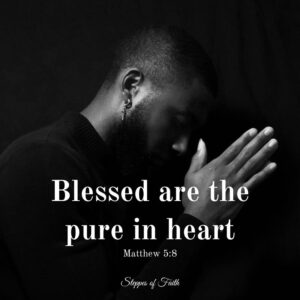

“Blessed are the pure in heart.” Matthew 5:8
Genesis 4 retells the story of Adam and Eve’s sons, Cain and Abel. Abel kept sheep, and Cain tended the garden. Eventually, God called them to present an offering.
“In the process of time, it came to pass that Cain brought an offering of the fruit of the ground to the LORD. Abel also brought of the firstborn of his flock and of their fat.” (Gen 4:3-4, NKJ)
God accepted Abel’s offering but not Cain’s, causing Cain to become “very angry” and depressed (v5). God attempted to comfort Cain, but he maintained his anger, leading him to kill his brother and commit the world’s first murder (v8).
Initially, the story of Cain and Abel appears to be about sibling rivalry. But if we look more closely, it is more of a lesson in proper worship. Worshipping the King of the Universe requires reverence and truth. Therefore, with regard to Cain and Abel, the issue was not what they offered to the Lord, but their heart postures.
Notice that Abel brought “the firstborn of his flock and their fat” to the Lord in verse four. The theme of firstborns is common throughout the Bible, most notably in the New Testament gospels and the life of Jesus. The firstborn males are especially honored. So, when Abel brought the firstborn sheep plus its prized fat, he made his heart posture toward God very plain.
Cain, on the other hand, just brought “the fruit of the ground.” The New International Version of the Bible says Cain brought “some of the fruits of the soil.” In other words, Cain simply gathered a bunch of produce in a basket and handed it to God. He, too, made his heart posture very plain. Proper worship was not important to him, and so God rejected his offering.
Putting Your Heart in It
As modern believers, it can be easy to become complacent about worshipping the creator of the universe. Amid the busyness of life, attending church can become merely a check on the Sunday “to-do list.” And while there, some may lift their hands and sing along, but it is just a mindless habit. Their heart is not in it.
To make matters worse, when they suddenly find themselves in a valley instead of on a mountain top, they wonder, “Where is God?” Some might even become angry like Cain. But notice how God responded to Cain’s anger.
“Then the LORD said to Cain, ‘Why are you angry? And why has your countenance fallen? If you do well, will you not be accepted? And if you do not do well, sin lies at the door. And its desire is for you, but you should rule over it.” (Gen 4:6-7)
God did not chastise Cain; He comforted him and told him what he should do (“do what is right”). This is commonly known as conviction. When we sin, God convicts us to turn away from it and get back on track with Him. He never condemns us (Rom 8:1) but lovingly calls to us to return to Him.
Rule Over Your Sin
Unfortunately, Cain remained angry, which is why God cautioned him.
“Sin lies at the door. And its desire is for you, but you should rule over it.”
Jesus repeats this caution after Peter’s three denials.
“And the Lord said, ‘Simon, Simon! Indeed, Satan has asked for you that he may sift you as wheat.” (Luke 22:31)
Satan desires to sift all of us like wheat. But thanks to our Lord and Savior, Jesus intercedes for us as our great High Priest (Rom 8:34; Heb 7:25; 1 Jn 2:1) so that our faith will not fail (Lk 22:31).
Still, Satan never gives up. He continually tempts us to sin. It is always crouching at the door, which is why God commands us to rule over it. We can only achieve that by changing our heart posture.
True and proper worship starts with the correct heart posture.

Changing Your Heart Posture
Proper worship of our Lord and Savior includes a deep sensation of thanksgiving that we long to express. But when our heart posture is off, our worship is off.
How do we change our heart posture? How can we deal with sin so that our worship is true and proper?
Guard the Door to Your Heart. God said, “Sin lies at the door” in Genesis 4:7, meaning we must not allow Satan to get a foothold. We cannot allow him to overtake us.
James 4:7, “Therefore, submit to God. Resist the devil, and he will flee from you.”
1 Corinthians 10:13, “God is faithful, and he will not let you be tempted beyond your ability, but with the temptation he will also provide the way of escape, that you may be able to endure it.”
Guarding the door means we must fight the enemy’s attacks every day. But when the attacks seem overpowering, God will mercifully give us a way out if we seek it.
Repent. Repent does not indicate confession solely. Its original meaning is to turn and move in the opposite direction by 180 degrees. Repenting involves giving up the sin that held you, giving it to God, turning toward Him, and following Him daily.
Shine a Light. Walking away is not always so easy. Sometimes we want to return to our sin (Prov 26:11), which is why we should never fight sin alone. We must shine a light on it so that the darkness Satan imposes can never take hold. We do this by getting into community—Bible studies, small groups, etc. Being in community allows others to walk beside us, share our struggles, and lovingly hold us accountable.
Being in community with other believers makes a world of difference in how we fight sin.
Remember God’s Grace
Above all, we must remember God’s enduring grace. His grace is always bigger than our sin. Recall His words to Cain.
God punished Cain by making him restlessly wander the earth. Cain expressed his fear that “whoever finds me will kill me.” But God graciously replied, “Not so. Anyone who kills Cain will suffer vengeance seven times over.” He then put a visible mark on Cain as a warning that if anyone harmed him, God would end their life.
God’s mark on Cain indicated that, though Cain sinned, God still loved His child. It was an outward way of saying to others, “This one belongs to Me.” This is a wonderful reminder that, despite our sin, those who faithfully follow the Lord will find mercy.
1 John 1:9, “If we confess our sins, he is faithful and just to forgive us our sins and to cleanse us from all unrighteousness.”

God’s Grace > Your Sin
Notice that God did not wait for Cain to confess. He already knew Cain’s heart, which is why He made the first move. In so doing, He showed Cain His mercy. However, He disciplined Cain—there were still consequences—but He did not destroy him. God has that same grace for us all. Romans 8:28 says,
“There is therefore now no condemnation to those who are in Christ Jesus, who do not walk according to the flesh, but according to the Spirit.”
God will convict us through His Holy Spirit, but He will never condemn us for our sin. Instead, He uses our experiences to make “beauty from ashes.”
Romans 8:28, “And we know that all things work together for good to those who love God, to those who are called according to His purpose.
Sin does not have to define us. Though Satan does his best to overtake us, we must resist. But if we fall, we have the assurance that God will always forgive us when we ask for it (1 Jn 1:9). And if asking seems difficult, He will make the first move to draw us closer to His loving grace.
God longs to forgive; He yearns to draw closer to His children. The ancient Hebrews called it “zeroa netuyah,” God’s long “outstretched arm” of righteousness. He extends it out to us, inviting us to experience the power of His salvation and grace. It is far more powerful than our sin. So, even when asking for forgiveness is hard, God is already reaching out with His ever-ready grace.
Dealing with sin may not always be easy. Many times, it is not. Yet it is vital to our Christian faith to keep our heart postures oriented toward God. In turn, we rightly give Him our true and proper worship. He is worthy of it.


