

“Our Father in heaven, hallowed be Your name.” (Matthew 6:9; Luke 11:2)
The New Testament books of Matthew (6:9-13) and Luke (11:2-4) both record the Lord’s Prayer. Some people pray it word-for-word, and others use it as a model or example for proper structure. To be sure, either is acceptable to the Lord, though Jesus primarily intends it to be an outline of sorts.
But what really matters is Jesus’ message. We can better understand His teaching by examining His words and intent by looking at His famous prayer verse by verse.
For context, Matthew records Jesus teaching the prayer as part of His Sermon on the Mount (chapters 5-7). Luke does not. He records the Lord’s Prayer as occurring sometime later (see Luke 6:20-49). Luke only records that one of His disciples saw Jesus praying and then asked Him how he, too, should pray.
The discrepancy is because Jesus repeated His teaching (the Prayer) at two different times and locations. We can compare it to telling a story to one friend, then encountering a second friend several days later and repeating the story.
Staying in the book of Matthew, we see that Jesus had just finished teaching the crowd how to pray (6:5-7) and being generous to others (acts of charity, v1-4). He then followed with a similar message about fasting (v16-18). In each point Jesus makes—giving, praying, fasting—He is teaching us about daily living and the importance of humility in direct opposition to the “hypocrites (Pharisees).”
On the heels of such instruction, Jesus illustrates how we should pray to the Father. Notice that both Matthew’s and Luke’s accounts of the Lord’s Prayer begin the same way, but the rest is slightly different. To simplify, we will look at the similarities collectively and then address the remaining verses separately.
Notice the Lord’s Prayer is plural in nature (us, we, ours, etc.), not singular (I, me, my, etc.) in any way. The purpose of the Prayer is to honor God first, then to love people. It is community-focused on the body of Christ (the church) and not solely on us. We can pray for our personal needs, of course. But Jesus teaches that we should put the needs of other believers before our own.
Praise and Prayer
“Our Father in heaven, hallowed be Your name.” (Mt 6:9-10; Lk 11:2)
Jesus begins by giving the Father the praise He is due. Leading with praise is essential when we pray. Instead of jumping straight into asking for what we want or need, take a moment to recognize God for who He is—the Creator of all things, full of glory, honor, majesty, and blessing. He is holy (“hallow”), faithful, gracious, good, and loving. He alone is worthy of praise, so we begin our prayers to Him by petitioning for His name to be honored.
“Your kingdom come, Your will be done on earth as it is in heaven.”
This portion of the Lord’s Prayer is taken from the Qaddish (or Kaddish), an ancient Jewish prayer usually recited in Aramaic.
“Exalted and hallowed be His great name in the world which He created according to His will. May He let His kingdom rule in your lifetime and in your days in the lifetime of the whole house of Israel, speedily and soon. Praised be His great name from eternity to eternity. And to this, we say: Amen.”
Because God is so worthy, it should be our utmost desire for His kingdom to come and His will to be done in the church. Pray that God’s final rule and authority will be established on the earth just as it is in heaven and that all will submit to His purposes, plans, and glory.
Pray, too, that the church will work actively to introduce the gospel to unbelievers and provide a glimpse of the kingdom by the way we boldly practice godly righteousness in our daily lives.

Spiritual Nourishment
“Give us this day our daily bread.” (Mt 6:11; Lk 11:3)
This verse, found in both Matthew and Luke, has two meanings.
First, by praying for God’s provision, we acknowledge our humility and dependence on Him. We also acknowledge His faithfulness and kept promises, such as when God provided for the Israelites as they wandered in the wilderness.
- He sent a pillar of fire by night (for warmth and light), and a pillar of clouds by day (for guidance and shade from the sun, Ex 13:20-21)
- Water to drink from rocks (Ex 17:6)
- Safe passage across the Jordan River (Jos 3:14-17)
- Manna from heaven (Ex 16) and flocks of quail (Num 11).
For forty years, God provided everything they needed.
Such faithfulness is why Jesus tells us not to worry about what we should eat, drink, or wear (Mt 6:31-34). God already knows what we need. So why should we pray for our daily bread?
God invites us to invest in our relationship with Him so we may mature and strengthen our faith. And because God commands us to pray for other believers before we pray for ourselves (Mt 5:44; 1 Tim 2:1-2; Jam 5:16), we invite God to meet their needs as well.
The second meaning of “daily bread” is the word of God itself. When we pray for our bread, we pray for Him to fill us with His word, i.e., Himself.
“In the beginning was the Word [Jesus], and the Word was with God, and the Word was God.” (Jn 1:1, with addition)
Jesus is the Bread of Life (Jn 6:35). Satan did not acknowledge this distinction when he tempted Jesus in the wilderness and told him to turn the rocks into bread. But Jesus replied, “Man does not live by bread alone but by every word of God (Lk 4:3-4).” This is the same bread we see in the Lord’s Prayer.
Daily bread is not only physical food but also spiritual food. Pray for believers to be filled daily with God’s word—the Bread of Life—as well as physical nourishment so they can continue to walk in faith.
Prayer of Forgiveness
Matthew 6:12, “And forgive us our debts as we forgive our debtors.”
Luke 11:4, “And forgive us our sins, for also forgive everyone who is indebted to us.”
Matthew and Luke’s accounts of the Lord’s Prayer now begin changing slightly. Matthew asks for forgiveness of debts, while Luke asks for forgiveness of sins. Both say the same thing—we should ask God to forgive us of spiritual debts (sins).
Sinners are in debt for disobedience to His word. Our only path to forgiveness is through the Lord Jesus, who readily gives it fully and completely. But we do not ask only for our forgiveness but also for strength and compassion to forgive others.
In Matthew 18:21-22, Peter asks Jesus how often he should forgive a neighbor who keeps sinning against him. He asks whether seven times is enough, since forgiving someone seven times seems like an unimaginable number of times. But Jesus replies, “I do not say to you up to seven times but up to seventy times seven.”
Jesus is not asking us to do any math. He is instructing us that mercy for others must have no end, just as God’s forgiveness for us has no end. Aside from love, forgiveness is the gospel’s central theme. Therefore, when we pray the Lord’s Prayer, we ask Him to forgive what we owe Him in proportion to the forgiveness we show others for what they owe us. If we can repeatedly and mercifully forgive others, God will forgive us just as much.
God knows it is challenging for our sinful natures to forgive a repeated offense. Pray for His mercy and strength to make it possible in how we live and interact with others, especially an enemy (Mt 5:44-45).
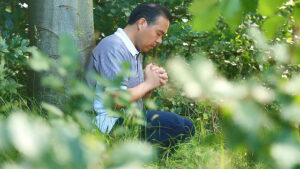
Deliverance and Escape
“And do not lead us into temptation but deliver us from the evil one.”
Matthew and Luke both use the same words in 6:13a and 11:4, respectively. Here, “the evil one” is specified to clarify that it is Satan and not God. God does not tempt us (Jam 1:13), but He allows us to experience trials. The stories of Job and Peter are good examples.
Satan uses every method possible to tempt us to sin and rebel. Jesus even says we should expect trials and tribulations (Jn 16:33). Satan may tempt us more than we might like, but God promises He will always provide a means of escape (1 Cor 10:13).
Sometimes, deliverance is immediate. Other times, it is through endurance so that God can refine our faith like gold (1 Pt 1:7). The truth is, God may not always answer our prayers the way we want. Regardless, Jesus instructs us to pray for deliverance from persecution and temptation to sin. Such a petition acknowledges our spiritual reliance on God’s provision and protection.
Just Pray
The final part of the Lord’s Prayer is found only in the book of Matthew. Luke does not mention it at all.
“For Yours is the kingdom and the power and the glory forever. Amen.” (Mt 6:13b)
Though this final praise was not in the original biblical manuscripts, the message is the same. Just as we should begin our prayers with praise, we should always end them with praise for the same reason—He is worthy.
God does not require us to pray the Lord’s Prayer word-for-word or even follow its structure. However, He encourages us to remember what matters most when we do—that He will meet our daily physical needs, provide spiritual nourishment, forgiveness for ourselves and others, and strength to resist temptation.
God is able to provide all these things and so much more. All we have to do is pray.


