

“Then the Pharisees and Sadducees came and tested [Jesus].” (Mt 16:1)
The New Testament gospels record that Jesus often bumped heads with the Sadducees and Pharisees, the religious leaders in Israel. One such famous leader was Caiaphas, the high priest at the time of Jesus’ arrest (Matt 26:57; Mk 14:53; Lk 22:54; Jn 18:12).
Both Sadducees and Pharisees were influential leaders during the Second Temple period. They relied heavily on the Torah in their faith, but their approaches to it and the community varied.
Who were these groups of people? How were they alike, and how were they different? Do they still exist, and will they ever come back into power? We will start first with the Sadducees.
The Sadducees
The Sadducees (from the Hebrew word sadaq, “to be righteous”) evolved from the Levitical priestly line of Zadok, who served King David (2 Sam 15:24-29) and later anointed Solomon as king (1 Kgs 1:38-39). They included the high priests (such as Zacharias, Lk 1), chief priests, and aristocratic families of the day and held the majority of the 71 seats in the Sanhedrin, the ruling council in Jerusalem.
Sadducees only used the Torah in their doctrine (Genesis-Deuteronomy), and they believed in it deeply. However, they denied several of its teachings, including the power of resurrection and the hope of an afterlife (Gen 3:19; Ex 15:1; Deut 31:16, 32:39), leaving the people with a sense of occasional hopelessness.
One of the Sadducees’ primary duties as priests was to maintain orderliness in the temple, which they took very seriously. Recall their reaction after Jesus overturned the tables in the Temple and then healed the “blind and lame”.
“But when the chief priests and scribes saw the wonderful things that He did, and the children crying in the Temple…they were indignant.” (Mt 21:14-15)
The next day, the Sadducees angrily confronted Jesus (Mt 21:23), as they often did, and soon after they plotted to kill Him. Other times the Sadducees confronted Jesus include Matthew 16:1, when they asked for a sign from heaven, and in Mark 12, when they questioned resurrection power.
The Sadducees also often worked with Roman officials. Their close working relationship allowed them to continue appointing a succession of handpicked priests and maintain community peace to their liking.
Because of their association with the Romans, many considered the Sadducees more of a political group than a religious sect. According to ancient historians, their wealth, power, arrogance, and argumentative nature often made them largely unpopular with everyday people. People simply did not trust them, at least not completely, yet they were subject to them.
The Pharisees
In many ways, Pharisees (from the Hebrew for “separated”) were the opposite of the Sadducees.
Unlike the aristocratic Sadducees, the Pharisees were comprised of people in the Jewish middle class, legal scribes, and synagogue leaders who divided into two distinct sub-groups—the Shammaites and the Hillelites.
Conservative Pharisees (Shammaites) were anti-Rome and anti-Gentile, while liberal Pharisees (Hillelites) took a more gracious approach toward the people. Their internal opposition eventually led them to worship separately while still working together.
The Pharisees’ primary goal was to keep Torah as perfectly as possible. They taught that all Jews—including Jesus—had to keep its 600-plus laws. They also included the writings and books of the prophets (i.e., the entire Old Testament) in their doctrine (the Sadducees focused only on the Bible’s first five books), as well as oral traditions (Mishnah), which continued to grow over time. Unfortunately, they often equated their traditions with God’s word (Matt 9:14; 15:1-9; 23:5, 16, 23; Lk 11:42), prompting Jesus to call them hypocrites in Mark 7:6 and to publicly remind them of Isaiah 29:13.
“And the Lord said: “Because this people draw near with their mouth and honor Me with their lips, while their hearts are far from Me, and their fear of Me is a commandment taught by men.” (Is 29:13)
Their drive for perfection and, thus, righteousness typically gave rise to overinflated piety. The Sabbath proved an extraordinarily prickly day for them, with many people breaking the law. Two examples are when they became upset after Jesus healed the sick multiple times and when He allowed His hungry disciples to pick wheat (Mt 12:1).
“And when the Pharisees saw it, they said to Him, ‘Look, Your disciples are doing what is not lawful to do on the Sabbath!’” (Mt 12:2)
Jesus was not the only one to note the Pharisees’ disposition. The people also did not consider them to be popular. However, because the Pharisees did not overly concern themselves with politics and Rome, the people preferred them over the Sadducees.
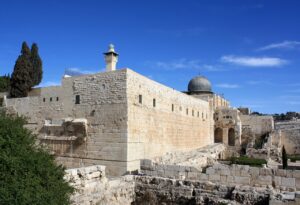
The remains of Solomon’s Temple where Pharisees and Sadducees met as the Sanhedrin.
Working Together?
Though very opposite, the Sadducees and Pharisees worked together in the Sanhedrin, the ruling Jewish council and tribunal in Jerusalem. The Sanhedrin’s job was akin to that of a Supreme Court, where they would hear civil, criminal, and religious cases.
As mentioned, the Sadducees held the most seats on the 71-member council. The high priest, who presided over the Sanhedrin, was also typically a Sadducee, causing the verdicts to lean in the Sadducees’ political favor. Nevertheless, both religious groups managed to work together.
Outside of formal meetings, however, it appears the only time the Sadducees and Pharisees ever worked together was when they successfully conspired to kill Jesus (Mk 14:53, 15:1; Jn 11:48-50). The Bible records that the only religious leaders who refused to participate in their sham schemes were Nicodemus and Joseph of Arimathea, both Pharisees.
Where Are They Now?
Today, neither Sadducees nor Pharisees formally exist. Both fell out of power soon after the Romans destroyed the temple in 70 A.D. But the Pharisees carried on (in a sense) through the Mishnah (rabbinical writings and oral traditions). Modern-day synagogues and rabbinical Judaism as we know it are primarily based on the Pharisees’ work.
Scholars are undecided over whether the Sadducees and Pharisees will ever return to power. The Bible mentions the reimplementation of animal sacrifices in the coming Millennial Kingdom (Ez 40-48; Is 56:6-8; Jer 33:15-18; Zech 14:16-21), which might indicate the re-establishment of a type of priestly system similar to that of ancient times. But the Bible does not explicitly tell us.
One thing we can be fairly confident about is that the formal re-establishment of a Sanhedrin in the Millennial Kingdom is unlikely, since Jesus will conclusively defeat Satan and sin during the Tribulation (Rev 21) and finally and unequivocally rule over heaven and earth for eternity, leaving any future formal religious leaders unnecessary.


