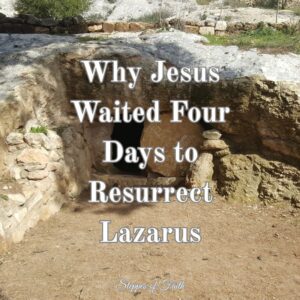

“So, when [Jesus] heard that [Lazarus] was sick, He stayed two more days in the place where He was.” (John 11:6)
John 10-11 tells of Jesus traveling across the Jordan River to an unpopulated area of Judea (likely Perea or Batanea) after escaping an angry mob seeking to kill Him (22-40). While He was there, He received word that His good friend, Lazarus, was ill.
“Therefore, the sisters sent to Him, saying, ‘Lord, behold, he whom You love is sick.” (11:3)
Curiously, Jesus did not run to his friend’s side but stayed in Jordan another two days before traveling to Bethany. By the time He arrived, Lazarus had been in a tomb for four days. When Martha, Lazarus’ sister, saw Jesus, she cried, “Lord, if You had been here, my brother would not have died (11:32).” But Jesus was not concerned. Instead, He calmly said, “Take away the stone” (v39).
In the Jewish culture, when someone dies, the family must bury the body within twenty-four hours. People in the ancient world believed that if the person were not actually dead and suddenly became well, it would most likely occur within one day of the burial, which is day two. By day three, if the person still had not come out of the tomb, everyone believed that person was indeed dead. By day four, the person was definitely, no question, without a doubt, dead.
Mary and Martha likely assumed that their friend Jesus would arrive by the second day when healing their brother was still possible. But then the third day came, and Jesus was not there. So, by the fourth day, everyone believed that Lazarus was undoubtedly dead, and there was no hope of saving him.
But on the fourth day, Jesus arrived and performed one of the greatest miracles found in the Bible.
“He cried with a loud voice, ‘Lazarus, come forth!’ And he who had died came out bound hand and foot with graveclothes, and his face was wrapped with a cloth. Jesus said to them, ‘Loose him and let him go.’” (vv43-44)
All For His Glory
It seems odd that Jesus would wait so long to travel to Bethany and help His good friend. Why did He wait? He gives us the answer back in verse four, when He was still in Jordan, speaking to His disciples.
“This sickness is not unto death, but for the glory of God, that the Son of God may be glorified through it.”
Jesus then confirmed it when He arrived at the scene and spoke to Martha, telling her to take the stone away from the tomb entrance. Naturally, Mary was quite apprehensive. She reminded the Lord of the overwhelming smell that would escape the tomb. But Jesus replied to her,
“Did I not say to you that if you would believe you would see the glory of God?” (v40)
Then, Jesus prayed, saying,
“Because of the people who are standing by I said this, that they may believe that You sent Me.” (v42)
Waiting four days was all part of Jesus’ plan.
Resurrecting Lazarus on the fourth day illustrated to the crowd and to us today that Jesus is indeed the Son of God and the promised Messiah. He holds all power and knowledge, and He is sovereign over every circumstance. As Jesus Himself said, Lazarus’ resurrection testifies of His glory and deity. And one day, His power will be fully known to all when the dead rise at His command in the last days (John 5:25, 28-29).
Lazarus’ resurrection also teaches us something else: What may seem hopeless to us is never hopeless to Jesus. He is Lord of all and over all, the King of all kings. So, in those times when all seems lost, His faithfulness, love, and power are steadfast, and we can completely trust Him. Nothing is impossible for Him (Lk 1:37).
Romans 8:28 tells us He works all things together for the good of those who love Him. We can hold onto that beautiful promise, knowing He is fully in control. Nothing can stop His good plans. Not even death.


