
“Then they crucified Him and divided His garments, casting lots.” (Mt 27:35)
For centuries leading up to Jesus’ time, casting lots was a standard method of determining an outcome or making decisions. The book of Leviticus is the first place in the Bible where God instructs the Israelites to cast lots.
In Leviticus 16, God instructs Aaron, the first high priest of Israel, how to make a burnt offering to atone for sins. First, he was to kill a bull to atone for his personal sins and those of his household. Then, he was to take two goats. One was sacrificed to the Lord (the blood offering). The other goat became a sin offering to atone for all of Israel. The priest would lay his hands on the goat to transfer the sin onto it, and then the goat was set free into the wilderness. This is where we get the term “(e)scapegoat.”
How did Aaron determine which goat he was supposed to sacrifice? By casting lots. See Leviticus 16:8-10, 20-22.
Hundreds of years later, as Jesus hung on the cross, Roman soldiers callously and prophetically cast lots for His tunic.
“Then they crucified Him and divided His garments, casting lots, that it might be fulfilled which was spoken by the prophet, ‘They divided My garments among them, and for My clothing, they cast lots.’” (Mt 27:35; Ps 22:18)
Mark 15:24 says the soldiers cast lots “to determine what every man should take.”
Acts 1 then describes a scene in the upper room where the apostles try to decide who should replace the recently deceased Judas Iscariot as the twelfth apostle. The choice was between Barsabas and Matthias. Arguments were made for each man, so the apostles used lots to determine who would win the coveted spot.
“And they cast lots, and the lot fell on Matthias. And he was numbered with the eleven apostles.” (Acts 1:26)
No one casts lots today, so what are they?
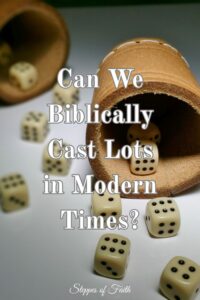
Lots could be almost anything according to local custom, but usually, they were stones, polished sticks, coins, or something similar. Today, we cast lots with cards, dice, or flipping a quarter.
The primary reason for casting lots was to render an impartial, unbiased decision on important matters. The objective was that no one could argue that the decision was based on human intervention like nepotism, politics, favoritism, etc., once the lots were cast.
“Casting lots causes contentions to cease and keeps the mighty apart.” (Prov 18:18)
More importantly, it was a way to determine God’s will.
“The lot is cast into the lap, but its decision is from the LORD.” (Prov 16:33)

Using Lots Today
The crucifixion and choosing an apostle are the only two New Testament instances of casting lots. However, in the Old Testament, the Israelites often used lots to reveal God’s purposes. For example, we see lots used in,
- Joshua 14:1-2 (dividing the 12 tribes of Israel)
- 1 Samuel 14:38-43 (determining the guilty party)
- 1 Chronicles 24:31 and 25:8-31 (determining individual Levite duties in the Temple)
- Jonah 1:7 (determining who caused the violent storm)
One might wonder why we do not use lots to determine God’s will today. The answer is we do not need them.
Before the giving of the Holy Spirit (Acts 2:1-4), God allowed the practice as a means of guidance and discernment. But after He sent the Holy Spirit, the practice became unnecessary. Spiritual guidance is no longer left up to man but to God. He alone gives the believer discernment to make godly decisions.
When we look to the Lord for direction on an issue, the Holy Spirit is the One who shows us the way so that we always remain within the Father’s will. This is why sensitivity to the Holy Spirit is so essential to the Christian faith and in our daily walk with Jesus.
Casting lots might seem to be an easier way to make decisions. But if the lot is wrong, we take matters into our own hands and do not seek the Lord’s will. We cannot allow impatience and pride to get in the way of God’s plan. Therefore, we must seek the Lord in all circumstances.
Jesus tells us in Matthew 6:33 to “seek first the kingdom of God and His righteousness, and all these things shall be added to you.” Further, Proverbs 3:5-7 says,
“Trust in the Lord with all your heart, and do not lean on your own understanding. In all your ways, acknowledge Him, and He will make your paths straight. Don’t be wise in your own eyes.”
When we seek the Holy Spirit and God’s will first instead of depending on our own devices like casting lots, we can be sure that the outcome will always be the best course of direction.


